

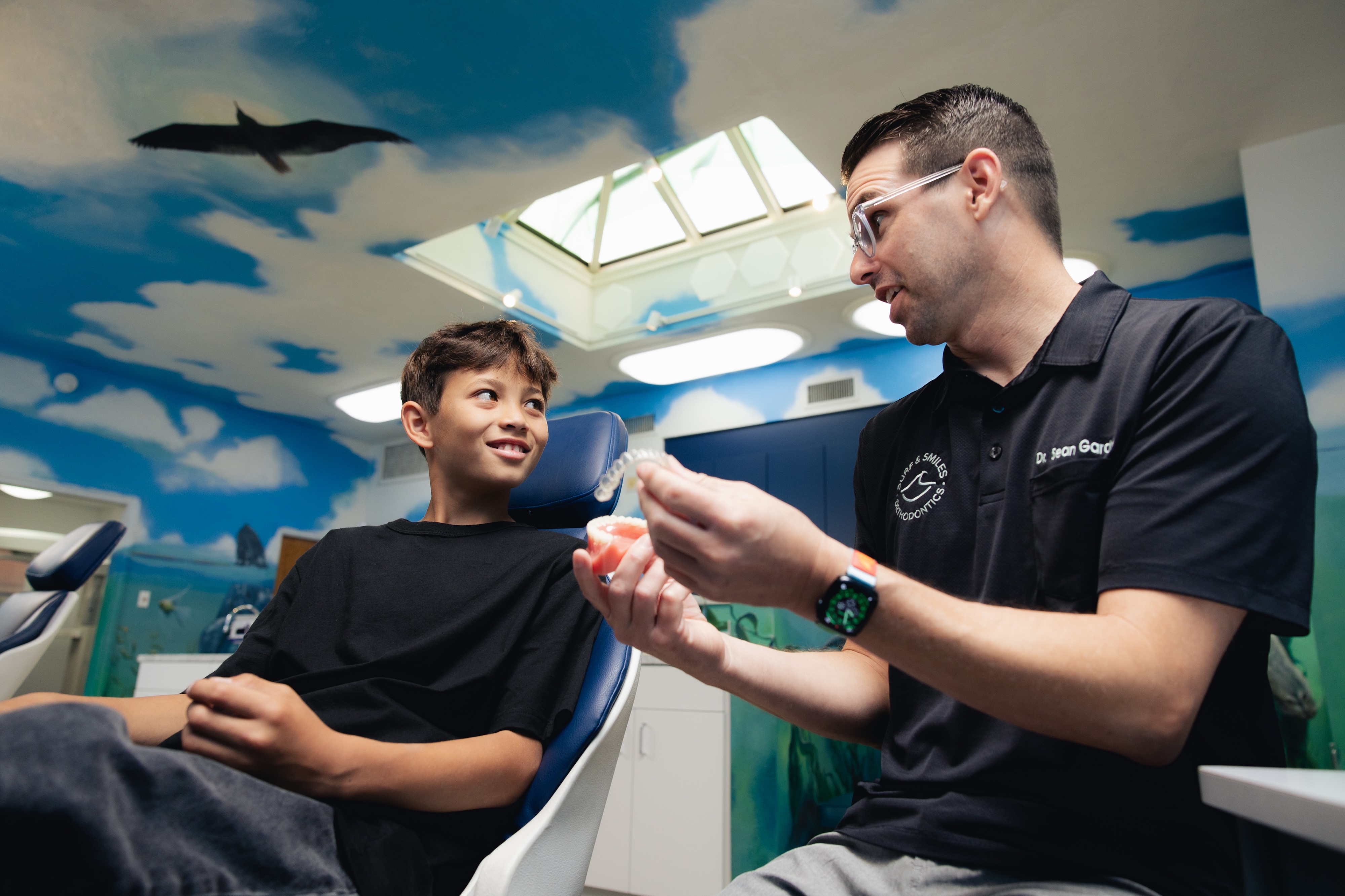
You're probably here because you've read about a dozen different Invisalign timelines online and none of them seem agree. Maybe one person wrapped up in six months while someone else is two years in and still getting new trays. You just want a straight answer before you commit to anything, and that's a smart way to approach it.
Most Invisalign cases take somewhere between 12 and 18 months. Mild crowding or spacing can finish closer to six months. More involved cases, especially ones with real bite correction, can run 24 months or longer. The range is that wide because two things swing enormously from person to person: how much your teeth actually need to move, and how consistently you wear the aligners.
Dr. Gardner and the team at Surf and Smiles Orthodontics work with patients and families across Vista, Fallbrook, and the surrounding areas to map out honest timelines from the very first visit, not the rosy estimates meant to get you to sign-on to care quickly.
We use the iTero digital scanner to create detailed 3D images of your teeth right from the start, so we can plan your treatment precisely and give you a realistic picture of what to expect. Below, we'll walk through exactly what drives that range so you can walk into any consultation already knowing what to ask. If you'd rather talk it through with a real person, our complimentary consultation is a good place to start.
Reach our Vista office at (760) 724-7887 or our Fallbrook office at (760) 728-5575.
The short version
- Most cases land between 12 and 18 months; simple ones can finish near six months, complex ones can pass 24.
- Case complexity is the single biggest factor. Bite correction and rotating teeth take longer than closing a small gap.
- Refinements (extra trays for fine-tuning) are normal once. Repeated rounds usually point back to planning or monitoring.
- Wearing your aligners 20 to 22 hours a day genuinely keeps you on schedule. Skipping time adds months.
- Your provider's planning quality shapes your timeline as much as your own effort does.
Case complexity is the biggest variable
More than anything else, your timeline comes down to what your teeth need to do to reach their finished position. Orthodontic cases sit on a spectrum, and where yours falls shapes everything about how long treatment takes.
If you've scrolled r/Invisalign or r/braces on reddit, you've seen people describe their cases in ways that probably sound familiar: "my ortho said it was moderate," or "I had an overbite plus crowding," or "one tooth is really out of place." Here's what those categories actually mean for your timeline.
Mild cases: roughly 6 to 12 months
A few teeth that need minor nudging — small gaps, light crowding, slight spacing. The movements are straightforward and the biology cooperates quickly. These cases tend to finish closer to the short end of the range, sometimes in as little as six months.
Moderate cases: roughly 12 to 18 months
More teeth involved, more distance to travel, or a combination of issues like crowding alongside a mild bite discrepancy. This is where most adult Invisalign cases land. Treatment is still very manageable, but it takes more trays and more time to get everything where it needs to be.
Complex cases: 18 to 24+ months
Cases at this end of the spectrum involve one or more of the following:
- Significant bite correction, like an overbite, underbite, or crossbite
- Multiple teeth with moderate to severe rotation
- Crowding complex enough to need careful movement sequencing or extraction planning
- Teeth that need to move vertically, not just side to side
More movement, more precision, more time. That's not a warning, it's just the honest picture of what the biology requires.
None of this is meant to worry you. The honest answer to "how long will this take?" lives inside the specifics of your teeth, and that's exactly why accurate records matter. We use the iTero digital scanner to capture a detailed 3D image of your teeth from the start, so you don't have to deal with putty. That detail makes it possible to read your case clearly and set expectations that actually hold up over the duration of your treatment.
Why refinements extend treatment, and when they're normal
Even with a solid initial plan, one thing catches plenty of patients off guard: refinements.
You've likely seen the posts. Someone thinks they're six months from done, then suddenly they're starting a whole new set of trays. The frustration makes sense. But refinements aren't automatically a warning sign. Often they're just part of the treatment when it is being done right, rather than "set it and forget it."
Refinements are additional aligners prescribed when teeth haven't moved exactly as the digital plan predicted, or when the final result needs a bit of polishing.
Teeth are living structures anchored in bone, and they don't always respond on a perfect schedule. A tooth that was supposed to rotate a certain amount might lag slightly behind. A bite that looked great in the simulation might need a small tweak in real life.
One round of refinements is genuinely common, and in many well-run cases it's anticipated from the beginning. At Surf and Smiles, we use the iTero digital scanner to create detailed 3D images of your teeth, allowing for precise treatment planning that keeps surprises to a minimum.
The distinction worth watching is between a refinement that's part of a carefully managed case and a pattern of repeated extensions that keeps shoving your end date further out.
- One refinement round after your initial series: normal, and usually expected.
- Multiple rounds stacking up, especially when nobody flagged tracking problems early: a different conversation, and it often traces back to the original plan and how closely progress was watched.
Good care means regular check-ins built to catch tracking problems before they compound. When a provider like Dr. Gardner is watching closely and correcting early, refinements stay minor and focused.
When oversight is thin, small issues quietly snowball. That's why choosing a provider on price alone can cost you more time than it saves.
Compliance affects the timeline more than most people expect
One of the biggest variables isn't your case complexity or how many trays you were given. It's how consistently you actually wear them.
Clear aligners work through steady, gentle pressure. The recommendation is 20 to 22 hours of wear a day, which leaves a small window for eating, drinking anything besides water, and brushing. When trays come out more often than that, teeth don't move as efficiently as the plan assumed.
Missing time on a single tray isn't a disaster. The problem is how it compounds. If your teeth haven't fully settled into one tray's position before you move to the next, the gap between where they are and where they need to be keeps widening. By the end, that can mean extra refinement trays and months you didn't budget for.
This is a real trade-off worth thinking through before you begin. Life happens: busy weekends, social events, the achy first couple of days with a fresh tray.
Aligners give you flexibility that braces don't, and that flexibility is genuinely valuable. It also means your outcome sits more directly in your hands. Patients who go in understanding that tend to have a much smoother ride.
How treatment planning quality shapes whether you finish on time
Here's the deeper question: even if you do everything right, does your provider's approach change how long treatment takes? Yes, and more than most people realize before they start.
Certification tells you someone finished a training program. It says nothing about how carefully they plan cases or how closely they monitor progress. A provider can be certified and still produce a plan that's overly optimistic, poorly staged, or slow to catch problems when aligners stop tracking.
What actually separates a well-planned case from a drawn-out one is a few things working together:
- Accurate digital records from the start, so the planning software works from precise data rather than approximations
- Realistic staging of tooth movements, so each tray asks teeth to do something achievable instead of rushing the biology
- Consistent monitoring at checkups, so tracking issues get caught and corrected before they quietly add months
That first piece begins with the iTero scanner.
Instead of trays full of putty, the handheld wand builds a detailed 3D image on screen in real time. It's quick, comfortable, and gag-free. More importantly, it gives a board-certified orthodontist an accurate foundation to plan from rather than an imprecise mold.
What a realistic timeline conversation should sound like at your consultation
Understanding how treatment works is one thing. Knowing what to ask when you sit down is another. A good consultation, whether with us or anyone else, should feel like a conversation.
Questions worth asking any provider
- How long have you been treating patients with Invisalign? Experience with the system matters, because complex cases need someone who has seen a wide range of outcomes and knows how to plan around them. Our lead orthodontist, Dr. Gardner, is board-certified by the American Board of Orthodontics, an achievement only one in three orthodontists reach.
- What percentage of your cases involve Invisalign? A provider who uses it regularly has a far more calibrated sense of what your timeline really looks like than one who offers it occasionally.
- Does the quoted price include refinements? That single question saves a lot of confusion later. A transparent office will walk you through what's included without making you feel like you're interrogating them.
We're upfront about finances: no hidden fees or surprises, affordable payment plans, pay-in-full discounts, and interest-free financing. We accept many dental insurance plans, and we'll take the time to answer every question so you can move forward feeling settled.
Ready to Get an Idea of Your Invisalign Treatment Timeline?
No article, forum thread, or online calculator can tell you how long your case will take. That genuinely requires someone looking at your actual teeth.
A consultation with Dr. Gardner is useful in a way that goes past just getting a number. Because he's treated cases like yours for years, you'll get a grounded estimate rather than an optimistic one.
If you're curious whether Invisalign fits your situation, or you just want an honest starting point, come in and ask every question you've been saving up. Two locations are ready to welcome you:
- Vista: 145 Cedar Road, Suite A, Vista, CA 92083, at (760) 724-7887
- Fallbrook: 425 E. Alvarado St., Suite C, Fallbrook, CA 92028, at (760) 728-5575
Whenever you're ready, we'll be here.
connect
with us
We can’t wait to meet you! Enjoy a Complimentary Consultation. Request an appointment online to set up your first visit. We’ll be in touch soon.