

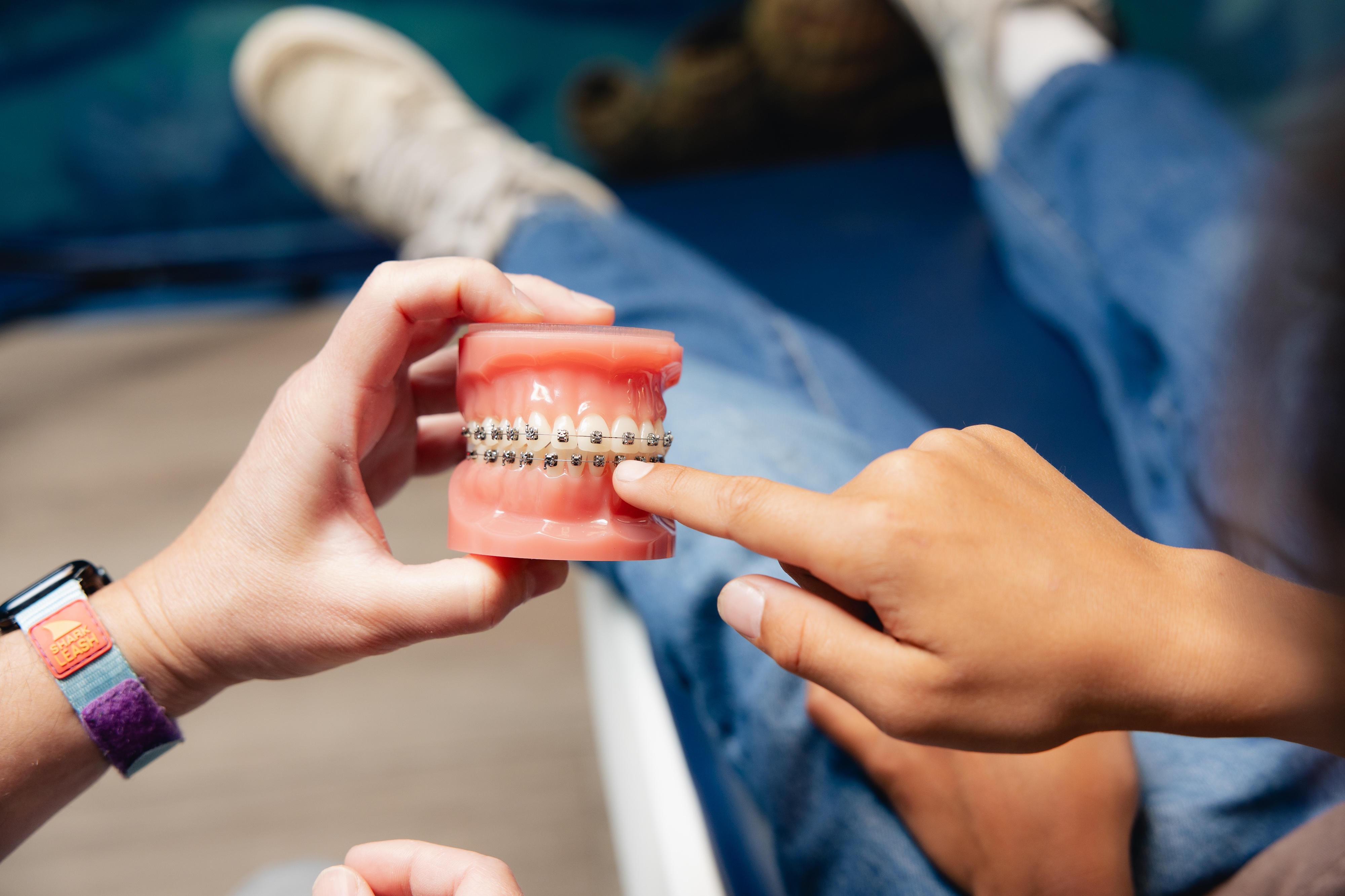
You've probably fallen down this rabbit hole already. It's late, you're scrolling, and one person online swears clear aligners changed their life while the next is convinced they wasted two years and should've just gotten braces. Then someone says it all depends on your case, someone else says it depends on your doctor, and you close your laptop with more questions than you started with.
So let's settle the main question right now. For most common orthodontic cases, clear aligners and traditional braces produce genuinely comparable results. The catch is that "most cases" carries a lot of weight in that sentence, and the person guiding your treatment matters just as much as the appliance you pick.
That's why it helps to work with a board-certified orthodontist who takes the time to map out the right approach for you. That's what the rest of this article walks through, along with a look at how we use the iTero digital scanner to plan treatment precisely. If you'd rather just talk it out, Dr. Gardner and the team at Surf and Smiles Orthodontics offer a complimentary consultation at our Vista and Fallbrook offices, and you can reach our Vista office at (760) 724-7887 or our Fallbrook office at (760) 728-5575.
The short version
- For mild-to-moderate cases, aligners and braces land in a similar place when the case is a good fit.
- Aligners tend to excel with predictable movements, adult patients, and anyone who'll wear them consistently.
- Braces keep a real clinical edge for severe crowding, big bite corrections, and cases needing precise control or steady, around-the-clock force.
- The single biggest factor in your outcome isn't the appliance; it's the training and judgment of the orthodontist planning your treatment. That's where Dr. Gardner, a board-certified orthodontist, makes all the difference.
- A good consultation should end with a clear recommendation, a timeline, and honest numbers, not a nudge toward one product.
What the clinical evidence actually shows
The research on clear aligners has grown a lot over the past decade, and the overall picture is encouraging. For mild-to-moderate cases, including spacing, mild crowding, and certain bite concerns, aligners tend to hold up well against braces in head-to-head comparisons. Tooth movement, alignment accuracy, and patient satisfaction have all been studied, and aligners perform solidly across those measures when the case suits them.
The nuance is in how uneven the studies can be. Some rely on short follow-up windows, small sample sizes, or older aligner technology that doesn't reflect what's available now. Aligner systems have changed so quickly that findings from even five or six years ago may not fully apply to current treatment, and the long-term comparative data is still catching up.
What that means for you is simple: the answer to "which is better?" really is case-dependent. Complex tooth movements, significant bite corrections, and certain growth-related issues in younger patients still tend to favor braces in the current evidence. Aligners shine elsewhere. The science supports both, just not as interchangeable swaps, and that's why the useful conversation is about your specific mouth rather than a general trend.
The cases where clear aligners work exceptionally well
With both tools clinically supported, the useful decision narrows to your bite, right now. So where do aligners tend to shine?
Aligners tend to do their best work in a few well-defined situations:
- Mild-to-moderate crowding
- Spacing between teeth
- Certain bite corrections where the needed movements are relatively predictable
- Adult patients with fully developed jaws, where the biology is stable
Adults often see excellent results partly because they tend to follow through on wearing their aligners. That matters more than people realize. The lifestyle perks are genuine clinical factors, not just talking points. Taking them out for meals, photos, or a big presentation makes treatment easier to live with, and hygiene is simpler when there are no brackets or wires turning flossing into a puzzle. For someone motivated and organized, removability is a real asset. If you want to talk through whether that fits your routine, a complimentary consultation is a great place to start.
It cuts both ways, though. If you tend to forget your aligners after lunch or struggle to hit the recommended hours a day, a fixed appliance that works around the clock without any cooperation may actually give you a more predictable result. The same goes for rubber bands: a plan that leans on consistent wear has a built-in vulnerability if that consistency isn't there. The honest version of this conversation happens upfront, not months into slow progress. Dr. Gardner will always give you the straight story before you commit.
Aligners are also a strong pick if a discreet option is what gets you to say yes to treatment at all. For working adults in Vista and Fallbrook juggling careers, social calendars, and the occasional beach day, that's not vanity; it can be the difference between fixing your smile and putting it off for another five years.
Figuring out whether aligners fit starts with a comfortable, thorough look at your teeth using our iTero digital scanner. A small handheld wand gently scans your teeth and builds detailed 3D images on screen right away, no messy putty or old-school impressions, and no gagging. It's quick and comfortable, and it gives us a precise picture of what your teeth are actually doing, which keeps the planning conversation grounded and specific to you.
Where traditional braces keep a clinical advantage
Sometimes that 3D iTero scan points clearly toward braces, and this is the part a lot of orthodontic content quietly skips. If you've read through communities like r/Invisalign or r/braces, you've seen posts from people who felt they were steered toward aligners, finished treatment, and still needed more work. That frustration is real, and it's worth taking seriously, not because aligners are bad, but because no single treatment fits every mouth.
There are specific case types where braces remain the stronger clinical choice:
- Severe crowding that needs controlled, precise movement over a longer arc of treatment
- Significant bite correction, including larger overbite, underbite, or crossbite issues
- Cases that demand precise torque control, where the angle and root position of individual teeth matter as much as surface alignment
- Younger patients whose consistency with a removable appliance is genuinely hard to predict
- Complex movements that benefit from the constant, fixed force brackets and wires provide
For kids and teens especially, wear-time is a real clinical variable, not a judgment on anyone's parenting. Aligners only work when they're in the mouth. Braces work around the clock because they're not going anywhere. When we place braces at both our Vista and Fallbrook offices, we use digital indirect bonding, which means each bracket is positioned with precision from the start rather than placed by hand chairside. That accuracy shows up in the outcome.
A good consultation is never about selling you a particular appliance. It's about reading what your teeth are actually doing and recommending what will move them most effectively. Sometimes that's aligners, sometimes braces, sometimes both. The right answer lives in the scan.
Why the provider matters more than the appliance
Here's where a lot of the online anxiety actually comes from, and it's justified. Some of the smartest questions we see are the ones people ask in orthodontic forums:
- How many years has this provider been treating with aligners?
- Does certification alone mean expertise?
- Does it matter whether I see a dentist or an orthodontist?
Those deserve a straight answer.
Invisalign certification, on its own, doesn't tell you much. A general dentist can complete a certification course and start offering aligners as an add-on. That doesn't make anyone a bad person, but the training foundation is different. Orthodontists finish dental school and then complete a separate, full-time residency focused entirely on moving teeth and aligning jaws. That's years of extra clinical training that shapes how someone reads a case, anticipates complications, and adjusts when treatment doesn't go exactly as drawn up.
Treatment planning is where that depth shows. The appliance is just a tool. What determines your result is how well someone understands your bite, your bone structure, your growth patterns if you're young, and how all of it interacts over time. A provider who does orthodontics all day, every day builds a clinical intuition that's genuinely hard to replicate.
That's the part we'd gently point you toward when you're comparing providers.
Dr. Gardner is board-certified by the American Board of Orthodontics, something only about one in three orthodontists achieve, and he plans every case around what the scan shows rather than a preferred product. He also speaks fluent Spanish, so that conversation can happen in whatever language feels most comfortable. Choosing your orthodontist isn't really about which appliance they stock; it's about trusting the person designing your smile from the very first scan.
How to size up your own case before you commit
You can do a lot of this evaluating yourself, right in the consultation chair. Since certification alone won't tell you how much experience someone has, or how willing they are to switch to braces when a case calls for it, ask directly. The providers who earn trust are the ones who treat both options regularly and can speak honestly about the tradeoffs.
You should also walk out with a clear picture of your timeline, what treatment looks like day to day, and what the money side involves. We're upfront about finances from the start: no hidden fees, flexible payment plans, pay-in-full discounts, interest-free financing, and we accept many dental insurance plans. Whatever you decide, you should leave feeling informed rather than sold to.
Ready to get a real answer for your smile?
If you've done the late-night research and you're ready to talk through what's actually right for your teeth, that's the kind of appointment Dr. Gardner enjoys most. Just an honest look at your case, your goals, and which path makes the most sense for you specifically.
Every new patient gets a complimentary consultation, so it costs nothing to come in and ask your questions.
We have two locations in North San Diego County, whichever is closer to you:
- Vista: 145 Cedar Road, Suite A, Vista, CA 92083 - (760) 724-7887
- Fallbrook: 425 E. Alvarado St., Suite C, Fallbrook, CA 92028 - (760) 728-5575
Whenever you're ready, give us a call to have a chat!
connect
with us
We can’t wait to meet you! Enjoy a Complimentary Consultation. Request an appointment online to set up your first visit. We’ll be in touch soon.